Few names sound as thoroughly Viking as Ragnar Lodbrok. Television has made him the face of the entire North – the cunning king, the defiant old man in the snake pit. But who was Ragnar really? The honest answer is: probably many people at once. Let us look closely at where the saga shines, where the sources fall silent, and what remains of the figure once the legend is peeled away.
Let us start with the byname, because it is the key to the whole figure. Loðbrók simply means „shaggy breeches" or „hairy trousers". According to the tale, Ragnar owes it to a piece of protective clothing: wrapped in tough, tarred or furry leggings, he slays a huge dragon or serpent to win the hand of the princess Þóra. So the hero carries his nickname not like an honorary title, but like an anecdote – a garment that became a legend.
Here the pattern of the entire tradition already shows itself: Ragnar is less a documented person than a point of crystallisation for stories. His dragon fight is an ancient narrative motif that recurs across dozens of cultures. It does not make him more historical, but it makes him immortal – and therein lies the appeal.
What we know about Ragnar comes from a handful of late texts. The most important is Ragnars saga loðbrókar, an Icelandic legendary saga from the second half of the thirteenth century – roughly four hundred years after the Viking Age in which Ragnar is supposed to have lived. To this we add the Ragnarssona þáttr, the „Tale of Ragnar's Sons", and the Krákumál, his death song from the twelfth century. The Danish chronicler Saxo Grammaticus also gives him a broad appearance in the ninth book of his Gesta Danorum.
These texts are heroic poetry, not history writing. They were composed by people who already knew Ragnar as a legendary figure and embellished him artfully. Anyone searching them for sober facts is confusing an epic with a report. The sagas are magnificent literature – and that is exactly how they should be read.
Hardly any episode is finer than the one about Ragnar's second wife. According to the saga, Aslaug is the daughter of the dragon-slayer Sigurd and the valkyrie Brynhild – with which the storytellers neatly attach Ragnar to the famous Völsung cycle. As a child she is hidden inside the body of a large harp and grows up under the name Kraka, „crow", as a soot-smeared servant girl, so that no one recognises her beauty.
When Ragnar's men anchor in the bay, the king sets her a test: she is to come to him neither clothed nor naked, neither full nor fasting, neither alone nor accompanied. Kraka solves the riddle threefold – wrapped in a fishing net and her long hair, biting into a leek, accompanied by a dog. Ragnar recognises at once that this woman is cleverer than her station, and marries her. The motif of the clever riddle-bride is among the oldest travelling tales of Europe – but nowhere does it sit as elegantly as here.
Ironically, Ragnar's sons are historically more tangible than he is himself. The sagas name, among others, Ívarr the Boneless, the brilliant strategist whose byname remains a puzzle to this day; Björn Ironside, the sea-king credited with a great Mediterranean expedition; Sigurd Snake-in-the-Eye, named after a serpent-shaped mark in his gaze; as well as Ubba and Hvitserk or Halfdan.
The historical anchor is the Great Heathen Army that invaded England from 865 onward. In 866/867 York fell, King Ælla of Northumbria met his death, and in East Anglia King Edmund was killed. Leaders such as Halfdan and Ubba are indeed attested in Anglo-Saxon tradition. Whether they were true brothers and the sons of a man named Ragnar remains open, however – the kinship is the literary glue that binds a historical invasion to a tale of revenge.
The most famous moment of the whole tradition is also its darkest. Ragnar, so the saga goes, is captured during a raid in England and thrown by King Ælla into a pit full of snakes. Dying, he speaks his defiant words: how the piglets would grunt if they knew how the old boar suffers – a barely veiled warning to his sons, who will take up the revenge.
The Krákumál, his death song, turns this dying into a manifesto of fearlessness. Across twenty-nine stanzas Ragnar looks back on a life full of battles, looks forward to his welcome in Valhalla and to the vengeance to come. The final line became perhaps the most famous Viking sentence of all.
„Laughing shall I die."Krákumál, 12th c. (Old Norse „Læjandi skal ek deyja", public domain)
One must be clear about this: this line is twelfth-century poetry, not the recorded last word of a dying man. It says less about how Ragnar actually died than about how the Northmen imagined a good death – without fear, with an eye on lasting fame and Valhalla.
The sober balance is a cautious one. There were real Viking leaders in the ninth century whose deeds may have flowed together into Ragnar – for instance commanders of the raids on Francia and England. Yet no contemporary source names a king „Ragnar Lodbrok" in a way that would allow a secure biography to be built. Ragnar is most likely a composite figure: the condensation of several historical men and travelling narrative motifs into a single, irresistible character.
That does not diminish his worth – quite the opposite. Ragnar has become a trademark of the Viking Age precisely because he bundles together what defines the era: voyages into the distance, clever women, mighty sons, the defiant gaze at death. He is true in the sense that good sagas are true.
Historically verifiable is the Great Heathen Army from 865 in England and the fall of York in 866/867, recorded in the Anglo-Saxon Chronicle; leaders such as Halfdan and Ubba are attested in Anglo-Saxon sources, and an “Ímar” (Ivar) as king of Dublin in the Irish annals. Contemporary sources also record the Viking assault on Paris in 845 under a leader named “Reginherus” – Latin for Ragnar – with around 120 ships and 7,000 pounds of silver in danegeld (Annales Bertiniani), and King Ælla of Northumbria (d. 867). These are the very threads the “Vikings” series draws on. The Ragnar texts themselves – Ragnars saga, Ragnarssona þáttr, Krákumál, Saxo's Gesta Danorum – exist as manuscripts of the twelfth and thirteenth centuries. What is certain, then, is the tradition, not the person behind it.
Ragnar as a single historical person cannot be securely identified; scholarship usually sees in him a condensation of several Viking leaders of the ninth century. The dragon fight, the snake pit and Aslaug's descent from Sigurd and Brynhild are saga motifs. The famous “laughing shall I die” is twelfth-century poetry, not an eyewitness account – and the “blood eagle” with which the sons are said to have avenged Ælla is disputed in source criticism (Roberta Frank, 1984, read it as a misunderstood skaldic kenning). The “Vikings” series invents freely on top of this: Rollo was not Ragnar's brother, the monk Athelstan is fictional, “Kattegat” is really a strait rather than a town, and almost a century of history is compressed into a single lifetime.
Few television shows have shaped the popular image of the Vikings as strongly as “Vikings” (History Channel, 2013–2020), created by Michael Hirst, with Travis Fimmel as Ragnar. It drew millions to the Viking age – and in doing so wove history, saga and pure invention into one gripping whole. To really understand the figure of Ragnar, it helps to know where the series draws on sources and where it simply makes things up.
A surprising amount has a historical core. The raid on Lindisfarne monastery in 793 was real and is seen as the signal fire of the Viking age. The siege of Paris the series stages so spectacularly reflects real events: in 845 a Viking leader named Reginherus – Latin for Ragnar – sailed up the Seine with around 120 ships; King Charles the Bald bought their withdrawal with 7,000 pounds of silver, recorded in the Annales Bertiniani. That is the strongest contemporary hint that a “Ragnar” may really have lived. King Ælla of Northumbria, Ragnar's legendary arch-enemy, is historical too – he fell at York in 867.
The series stands on firmest ground when it comes to the sons. In “Vikings”, Ivar, Björn, Ubbe, Hvitserk and Sigurd lead the great army to England – and that is exactly what their historical models do from 865: the Anglo-Saxon Chronicle names Ivar and Ubba, the Irish annals an “Ímar”, king of Dublin. The sons are better attested than the father. So anyone who loves the series is, in large part, loving real history.
And then the liberties. Rollo, the jealous brother in the series, has little in common with the historical Rollo: the real Rollo was born only after 860, founded the Duchy of Normandy in 911 with the Treaty of Saint-Clair-sur-Epte – and was demonstrably not Ragnar's brother. The monk Athelstan is an invention (not to be confused with the later English king Æthelstan). “Kattegat” is in truth not a place at all, but the strait between Denmark and Sweden. Above all, the series compresses almost a century – from 793 to the great army of 865 – into a single lifetime, turning the composite figure of Ragnar into one tangible, historical farmer-king. That is exactly what he is not.
The drastic scenes, too, call for caution. The “blood eagle” with which the sons avenge King Ælla is highly disputed as an actual execution rite: the Old Norse scholar Roberta Frank showed in 1984 that the saga authors probably misunderstood a skaldic kenning – the image of an eagle tearing the backs of the fallen – and only then built the gruesome ceremony from it. And Lagertha, Ragnar's shieldmaiden, comes from Saxo's Gesta Danorum around 1200; whether fighting women really existed is debated, yet the richly furnished warrior grave Bj 581 from Birka, genetically identified as female in 2017, keeps the question alive.
In short: “Vikings” is not a history lesson, but it is not pure fantasy either. The series takes real threads – Reginherus before Paris, the great army, Ælla, Lindisfarne – and knots them together with saga and screenplay. It is precisely this mixture that keeps Ragnar so alive today – and explains why so many find their way from the show to the real history.
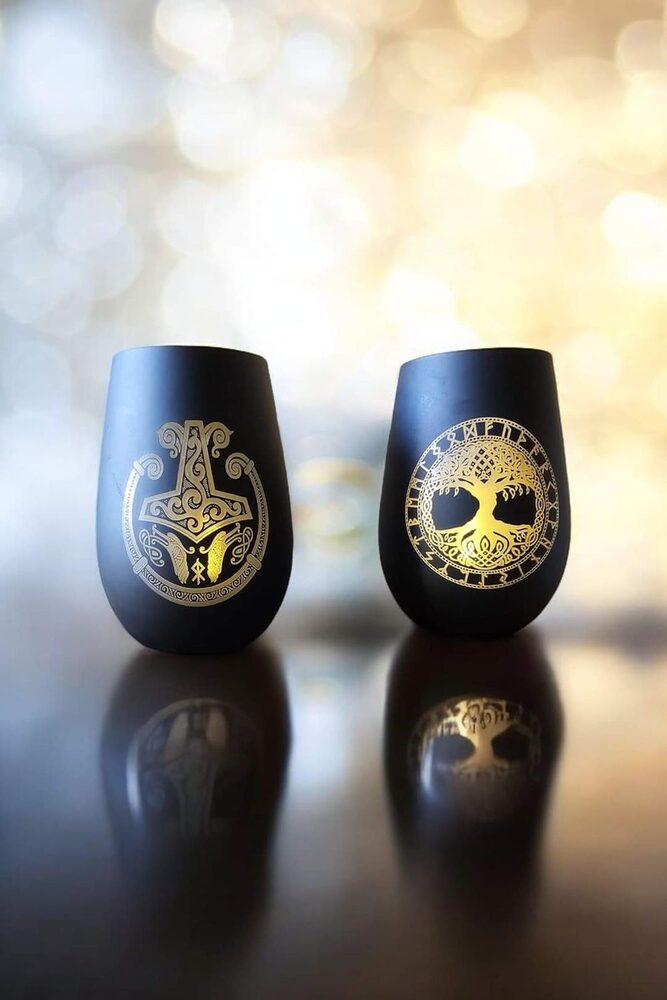
In the end Ragnar sticks so firmly in memory because he is not a file note but an attitude. A man who turns a name out of a pair of trousers, takes a clever servant girl as his queen and laughs in the face of his death – that is material one keeps retelling. For us he is an emblem of the fact that the finest stories of the North are rarely found in a chronicle, but live on in shared remembrance. And a motif that feels well kept in stone and wood.
Berserkers · The longships · The shield wall · The Great Heathen Army · Sigurd the dragon-slayer.