Before the runes became oracle stones in a pouch, they were simply the first alphabet of the North – for names, trade, remembrance and, yes, the odd cheeky line scratched on a wooden stick. We separate what is really old from what the modern age invented.
The Elder Futhark, with its 24 signs, is the oldest Germanic writing system, in use from about 150 to 800 AD. It was derived from a North Italic / Alpine alphabet (exactly which – Etruscan, Raetic or Latin – is disputed in scholarship). The name “Futhark” simply comes from the sound values of the first six signs: f-u-þ-a-r-k, just as “alphabet” comes from alpha and beta.

Not all runes are the same. There were three great rows: the Elder Futhark (24 signs), the Anglo-Saxon Futhorc (expanded to 29–33 signs, because Old English developed new sounds), and the Younger Futhark of the Viking Age with just 16 signs.
The biggest misunderstanding about runes is that they were primarily magical. The most important find of the 20th century says otherwise.
Honestly: there was a magical-religious side.
The famous runestones are above all a phenomenon of the Viking Age in Sweden, concentrated in Uppland – mostly memorial stones for the dead. The Rök stone in Östergötland carries, with around 760 characters, the longest known runic inscription and is regarded as the oldest piece of Swedish literature. Some stones are even signed: the runemaster Öpir (“the shouter”) carved around fifty stones in the elegant Urnes style in the 11th/12th century. Runes were carved into stone, wood, bone and metal.
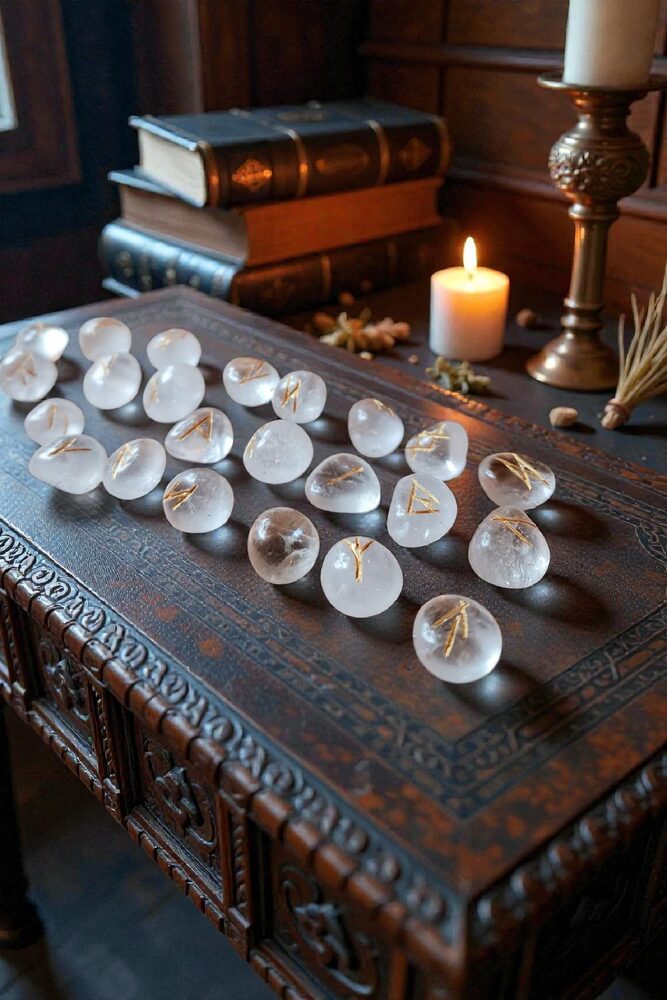
Want to get to know the signs yourself? Our Rune Lexicon has all 24 runes with their meanings, and with the Rune Name Generator you can write your own name in real runes.
There is no single set of „the" runes. Over the centuries several rune rows developed, and it is worth not mixing them up if an engraving is meant to be coherent. Three matter most for us.
The Elder Futhark is the original form: 24 characters, in use from roughly 150 to 800 AD. It is the rune row of the early Germanic peoples, long before the Viking Age proper. Its name simply comes from the first six characters: f, u, þ, a, r, k. Those who love runes for their archaic, full sound often reach for this one.
The Younger Futhark is the actual Viking rune row. Between about 800 and 1100 the alphabet shrank to just 16 characters, even though the language had more sounds, not fewer. A single rune therefore had to cover several sounds. The vast majority of surviving runestones in Scandinavia use exactly this row.
The Anglo-Saxon Futhorc went the opposite way: in England and the Frisian region the row grew to as many as 33 characters in order to capture additional Old English sounds. Even the name shifted phonetically to „Futhorc". Famous witnesses are the Franks Casket and the Ruthwell Cross.
The honest answer: first and foremost, runes were an ordinary writing system. By far the largest share of surviving inscriptions is remarkably down to earth: memorial stones for the dead, ownership marks („X owns this comb"), trade notes, the names of rune carvers, and the occasional bit of crude everyday humour. Standing before a runestone in a museum, you are usually reading an obituary, not a spell.
At the same time, there is genuine evidence of ritual and incantatory use. Amulets and bracteates carry formula words such as alu and laukaʀ, most likely meant as blessing or protection. The Sigrdrífumál of the Poetic Edda devote whole stanzas to „victory runes", „ale runes" and „birth-helping runes". And in Egil's Saga, Egill scratches out badly carved runes on a drinking horn meant to reveal poison and cuts them correctly anew. Runes as powerful signs are therefore not pure invention.
Myth check: the popular image of an all-purpose magical „rune oracle", in which every rune has a fixed esoteric meaning and is drawn like a card, is young in that form. Systematic rune divination sets and fixed interpretation tables stem largely from the romantic and esoteric revival of the 19th and 20th centuries, not from the Viking Age. The Vikings knew lot-casting, but there is no evidence they used our modern meaning cards. That makes runes no less fascinating, only more honest.
The most common beginner's mistake: swapping the Latin alphabet letter for letter. But runes represent sounds, not our spelling. „Christian" is therefore not built with a silent „h" but transferred by how it sounds. A „c" becomes k or s depending on pronunciation, a „v" often becomes f. If you want it historically coherent, you also choose the row on purpose: the Younger Futhark for a Viking connection, the Elder Futhark for the archaic, fuller set with more characters.
If you would like to try out your name, our rune oracle helps you get to know the characters. For a finished piece of jewellery or a slate, we handle the phonetic transfer and engrave it cleanly by laser: via Individual Engraving, or you can put your own design together in the engraving configurator. That way the right runes end up on the material, not the tempting wrong ones.
The Younger Futhark with 16 characters, in use from roughly 800 to 1100. It appears on the vast majority of Scandinavian runestones. The Elder Futhark with 24 characters is much older (around 150–800) and belongs to the early Germanic peoples; the Anglo-Saxon Futhorc went to England and Frisia.
Yes, sensibly transferred by sound rather than letter for letter. You follow how the word is pronounced and pick a rune row. That is exactly the transfer we carry out for an engraving so the result stays coherent and readable.
First and foremost they were writing. There is evidence of ritual use and formula words, but the fixed rune divination set with an interpretation table is largely a modern idea of the 19th and 20th centuries. You are welcome to use runes as a quiet prompt for reflection, but they should not be mistaken for a documented Viking practice.
Principle: runes were writing first. Where find and text show magical use, we say so; where the oracle is modern, we say that too.