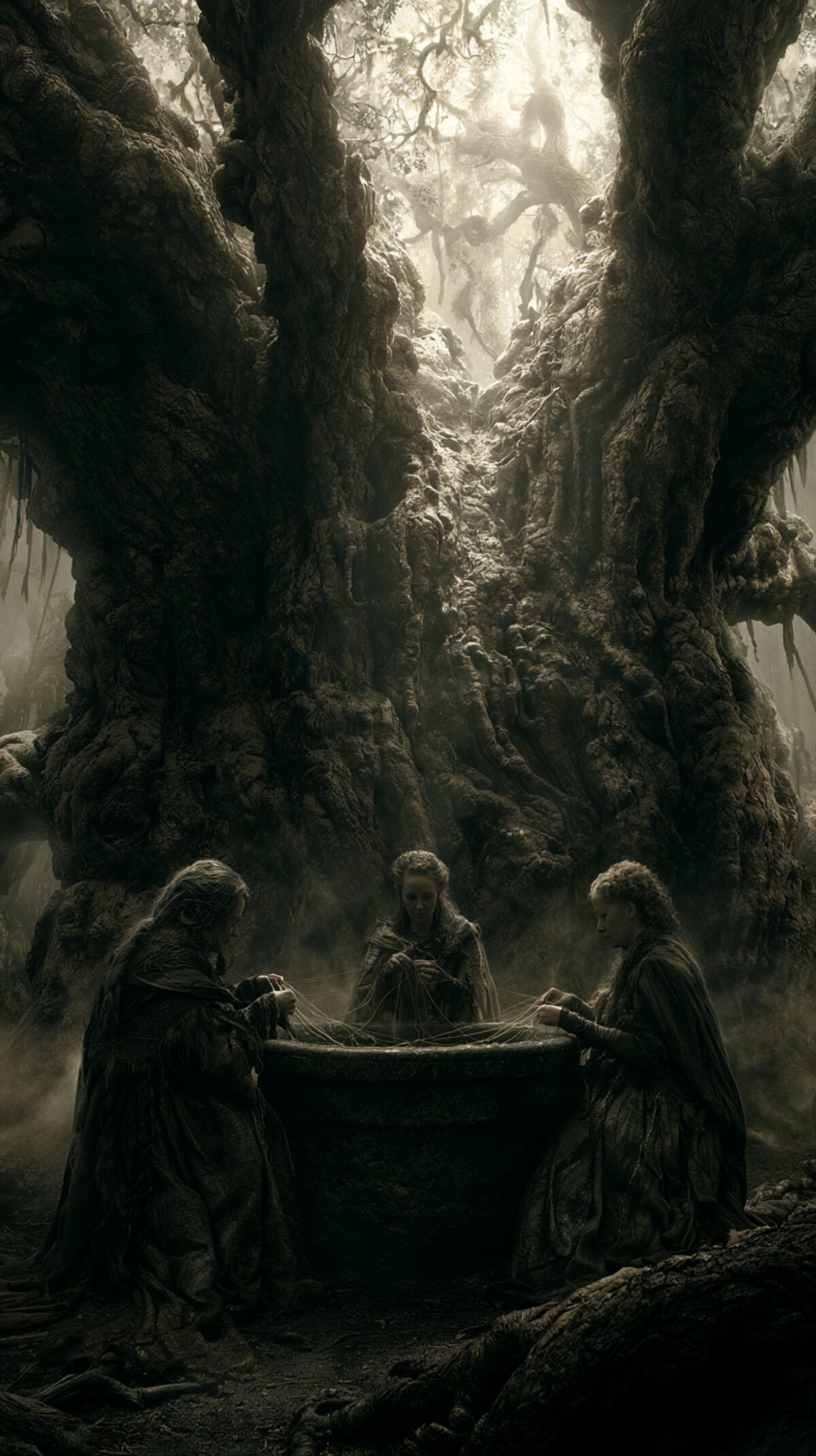
In the sagas of the North, no one sleeps harmlessly. A dream there is rarely a mere echo of the day, but a messenger: it announces death, a battle, a birth, or the betrayal already on its way. Whoever sees women step to their bedside in the half-dark knows that their fate has long since been spun. The draumr is a window – one may look through it, but not push back the hand against it.
For Old Norse storytelling, the dream is a serious matter. Where we today speak of processed impressions, the sagas saw in the draumr a message that comes from outside and carries meaning. Scarcely a great saga does without it: a hero lies down to sleep, and what he sees reaches ahead of what is to come. The dream is thus less an image of the soul than an anticipation of events.
These dreams rarely speak openly. They work with a dense symbolism – animals that fight, colours that give something away, blood that marks a person, women who wander through the night. The dreamer often does not understand the image himself; he needs an interpreter, or he recognises the truth only once it has come to pass. In precisely this delay lies the tension: the omen is present, yet its full meaning unfolds only with the fate it foretells.
Gísla saga Súrssonar shows this most vividly. The outlawed Gísli, a man who lives for years hunted at the edge of society, is visited night after night by two women in his dreams – the draumkonur. One is kind to him: she comforts him, speaks of mildness, of a worthy end. The other is baleful; she urges him toward violence and wishes to mark him with blood.
“Two women came to me in a dream; the one was kind to me, the other wished to mark me with blood.” after Gísla saga Súrssonar (public-domain translation tradition)
These two figures are more than emblems of an inner conflict. Scholarship most often reads them as fylgjur – protective and fate-bound spirits attached to a person and accompanying his lot. In Gísli's long outlaw life, the dreams become the true measure of his path: they weigh how much humanity and how much blood remain to him, and they lead him calmly toward his end.
Draumr Þorsteins Síðu-Hallssonar is just as unrelenting. Three women appear to the sleeper and plainly announce that his murder is near. Here there is no puzzling over colours and animals – the message is almost matter-of-fact, and that is precisely what makes it hard to bear. The dream does not warn so that one may evade it; it names what will happen regardless.
Such death announcements belong to the firm stock of dream scenes. The woman wandering in the night, often grave and sparing of words, is a recurring motif: a figure on the threshold between the living and what is coming toward them. She does not call for action, but invites the sleeper to accept the unavoidable with dignity.
Not every dream speaks of death. In Laxdæla saga, the young Guðrún Ósvífrsdóttir lays four dreams before the wise Gestr Oddleifsson, dreams she cannot interpret herself. Gestr recognises her whole life in them: the four images foretell her four marriages – each husband, each loss, each outcome. What Guðrún experiences as bewildering night-visions is in truth the outline of her future.
This scene shows a second side of the dream art: interpretation. The dream alone is mute; it needs someone who can read the signs. The interpreter thereby becomes a key figure himself – not because he makes the future, but because he lets it become visible before it arrives. For the saga's listeners this holds a double appeal: they learn early where the tale is heading, then watch the dreamed matter fulfil itself piece by piece.
Gunnlaugs saga, too, knows the image that knows more than the dreamer. Here a dream appears of two eagles fighting over a swan-maiden – an emblem of the rivalry of two men over a woman, a rivalry that becomes their undoing in the saga. The motif of fighting animals is typical: birds, wolves, or bears stand in for people, and their strife anticipates the strife of men.
So the dreams condense the great forces of a saga into a single picture. Two eagles, one swan – and the core of the coming misfortune lies open. The dream is thus also a narrative device that puts into the audience's hands the threads by which the story is pulled.
Beneath all these images lies one conviction: the dream is a window on fate – on that weave of past and coming things which the Norse felt to be something set. One could recognise it, one could interpret it, yet one could not turn it aside. Gísli does not escape his end, Guðrún's marriages come as foreseen, the threatened sleeper dies.
Herein lies the true dignity of these dream scenes. They are not about flight, but about bearing. Whoever has foreseen his lot in a dream goes to meet it not smaller, but more composed. The dream does not take the terror from what is coming, but it gives a person the chance to face it upright – and that is exactly what the sagas honour.
The dream scenes named here stand thus in the transmitted texts: Gísli's two draumkonur in Gísla saga Súrssonar, the three death-announcing women in Draumr Þorsteins Síðu-Hallssonar, Guðrún's four dreams interpreted by Gestr in Laxdæla saga, and the dream of the fighting eagles in Gunnlaugs saga. It is also certain that scholarship largely understands the dream-women as fylgjur – personal protective and fate spirits; works such as those of Else Mundal and the entries in Rudolf Simek's handbook place these figures within a wide field of female guardian beings. The firm role of the dream interpreter as a figure who reads the signs is likewise well attested.
Be cautious about whether “the Vikings” really dreamed and interpreted this way. The sagas were written down centuries after the Viking Age in Christian Iceland; they are not a record of lived belief but crafted literature. There the dream is also a narrative tool that builds tension and deepens characters. That dreams counted as omens is plausible and fits Norse fate-thinking – yet the clear good/evil split of Gísli's two dream-women carries partly Christian traits, while the image-motifs themselves – wandering women, blood, fighting animals – remain Old Norse. So one reads here less a historical testimony than a striking literary distillation.
Seiðr – the magic · The Norns · The Edda · Gandreið – the witch-ride · Hafvilla – lost at sea.