
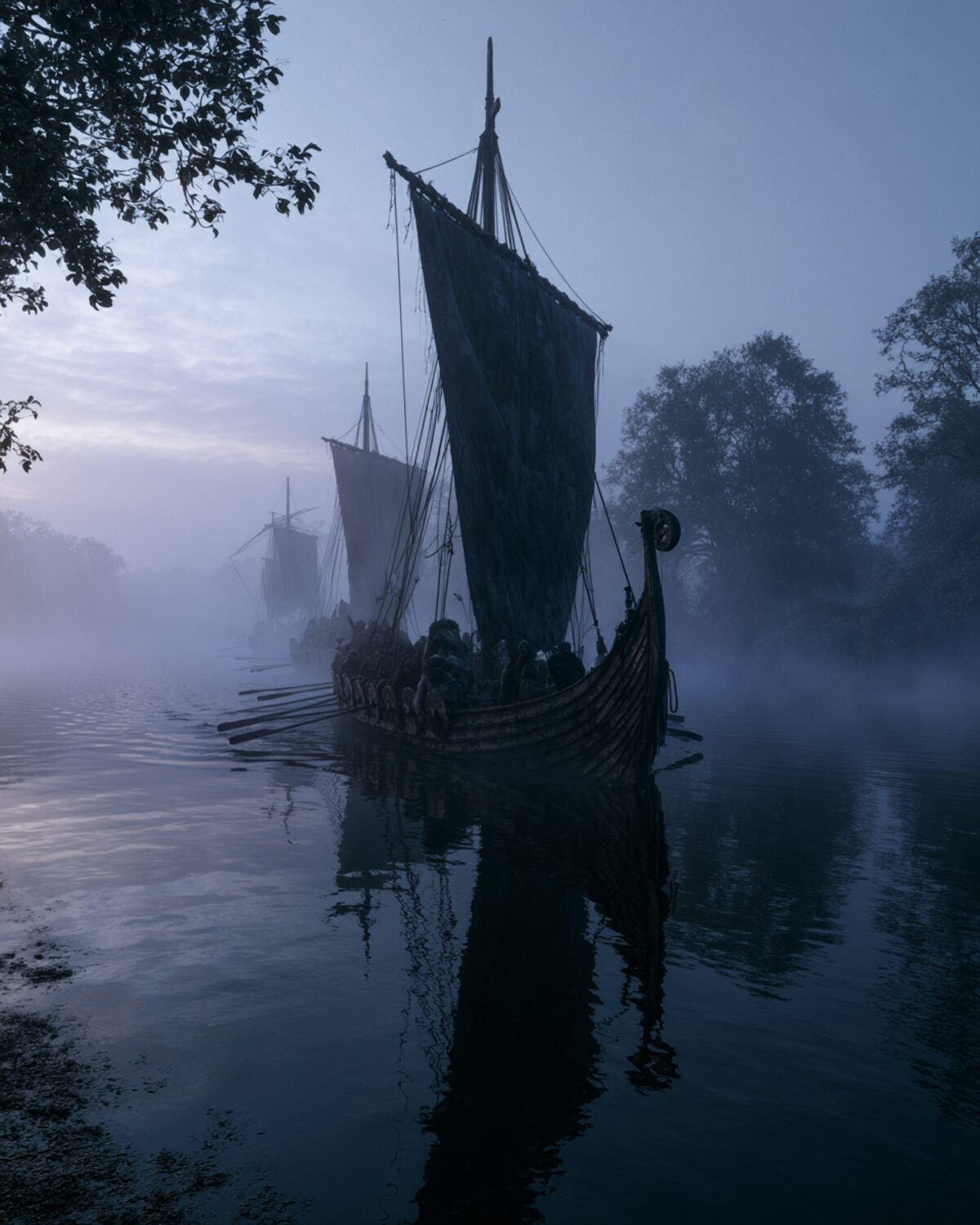
There is an Old Norse word for the quietest terror of seafaring: hafvilla, the “sea-bewilderment.” It does not mean the storm, nor the enemy on the shore, but something softer and more final – the moment a seasoned steersman searches the sky and finds nothing left to hold onto. No star, no coastline, no sun. Only water in every direction, looking the same wherever he turns.
The Vikings were not reckless chancers who threw themselves blindly onto the sea. They were experts of the open water, generations of steersmen who passed their knowledge down like a craft. And yet they had a word of their own for what they feared most. Hafvilla – made of haf, the high sea, and villa, confusion or going astray – describes no outer enemy but an inner loss: the collapse of orientation itself. Whoever fell into hafvilla no longer knew where north lay, where the destination was, how many days he had already drifted in the wrong direction. The ship kept moving, the oars kept working, the wind kept blowing – only none of it led anywhere anymore.
That so seafaring a culture coined a fixed technical term for this says a great deal. It was not a rare misfortune at the edge of experience, but a real and recurring danger that anyone sailing far west had to reckon with. Hafvilla belonged to the sea like the calm and the fog, and people spoke of it the way they might speak of an illness that could seize a man.
To understand why losing the way came so easily, one has to grasp how the Norsemen found their course at all. They had neither compass nor sea chart in the later sense. What they had was a dense web of signs they had learned to read. By day the sun gave direction – its rising, its highest point, its setting. By night the Pole Star, the leiðarstjarna or “leading star,” stood reliably over the north. To these were added the familiar landmarks of coasts, mountains and headlands, known by heart.
But the real art began where no land was in sight. Then the steersman read the sea itself: the flight of birds that pushed out onto open water in the morning and back toward land in the evening, so pointing the way to shore. The direction and character of the currents. The pattern of the waves, which changed where coasts or shallows broke the swell. The colour and temperature of the water, the shift from the deep sea to the coastal green. And the sea creatures – whales that followed certain banks, seabirds whose species betrayed nearness to land. From this wealth of detail a good steersman formed a picture of his position, constantly renewed, constantly checked. It was experiential knowledge of the highest precision, handed down across generations.
This whole fine scaffolding had one breaking point: it only worked as long as one could read. When thick fog rolled in, the sun vanished by day and the star by night. When a deep, closed layer of cloud settled over the sky, every reference line was gone for days. When a calm set in, the ship stood still, and with the movement went the sense of direction and time. In such conditions everything failed at once – the sun, the star, the wave pattern that could no longer be interpreted without a fixed bearing.
Then even the best steersman fell into hafvilla. The ship drifted blind, often for days, far off its intended course. The sagas tell of it in a sober, almost toneless voice that makes the matter only heavier:
“They were seized by hafvilla and for many days did not know where they were drifting.” after the Saga of the Greenlanders (public-domain translation tradition)
Note the word “seized.” In this language hafvilla is not something one does, but something that comes over a person – like a fever, like a spell. The man, with all his skill, becomes the one who is driven. Some ships found signs again after days that they could read, and fought their way back. Some reached foreign coasts they had never sought. And some never returned, and no one ever learned where the sea had carried them.
As threatening as hafvilla was, it also belongs to the greatest story of the Norsemen at sea. For the first recorded sighting of the American mainland by a European probably happened not out of daring, but out of pure going astray. Bjarni Herjólfsson meant to reach Greenland, where his father had settled. On the way he drifted off course and fell into hafvilla. When the visibility cleared again, before him lay a wooded, hilly coast that did not match Greenland – low, forested land where he had expected ice and bare mountains.
Bjarni was a merchant, not an adventurer. He did not go ashore, but corrected his course and sailed on until he found Greenland. Yet his account of the strange coast remained. Later Leifr Eiríksson bought Bjarni's ship and deliberately sailed back to that land – and became the name history kept. The irony is large and very human: the first European to see America saw it because he had lost his way, and left it lying there. Hafvilla, the seafarers' curse, was at the same time the gateway to a new world.
Hafvilla is a firmly attested Old Norse technical term of the seafaring sagas for the complete loss of orientation on the open sea. It appears in particular in the Vinland narratives, the Grœnlendinga saga and Eiríks saga rauða. It is equally certain that the Vikings navigated without compass and without a modern chart – by sun, Pole Star and landmarks, and by the flight of birds, currents, wave patterns, water colour and sea creatures. That these signs could all fail in fog, closed cloud cover or long calm, and that even experienced steersmen then fell into hafvilla, follows well from the sources and from the logic of navigation. The tradition that Bjarni Herjólfsson, driven off course on a Greenland voyage, sighted a strange western coast without going ashore, also belongs to the settled substance of the Vinland sagas.
A popular notion holds that the Vikings overcame hafvilla with a magical “sunstone” (sólarsteinn), a crystal that reveals the sun's position even through cloud. This is unproven and disputed. The term sólarsteinn appears only in one late-medieval mention, and the single calcite crystal often cited was recovered from the wreck of a ship from 1592 (Alderney) – a time long after the Vikings and with no Viking connection at all. Similar caution applies to the wooden Uunartoq bearing dial often interpreted as a “sun compass”: its function as a navigational instrument is interpretation, not proof. What is reliably attested is not the wonder-tool against losing the way, but the losing itself – hafvilla, which the sagas name outright.
Perhaps that is what is most moving about this word. It reminds us that skill and experience have their limit, and that the sea kept the last word. The Norsemen were masters of their craft – and knew at the same time that a single grey morning without sun was enough to undo all mastery. They sailed anyway. Again and again they put out into a water that could swallow them, because beyond the horizon lay land, trade, home, a new life. Whoever knows hafvilla understands a little better what courage each of those voyages demanded – and with what quiet awe these people looked to the sky on which their whole way depended.
The longships · Vinland · Ibn Fadlan & the Rus · Hedeby · Draumar – dreams as omens.